
Facilitating Freedom: Reflections from Path of Freedom Volunteers
- PMI Staff

- Jan 28
- 4 min read

Teaching mindfulness in prisons requires a delicate balance—one that our volunteers navigate with remarkable honesty and courage. The experiences they share reveal both the challenges and profound transformations that occur when contemplative practice enters correctional settings.
Balancing Awareness and Presence
One of our long-time volunteers addresses a fundamental tension in this work with striking candor: "I think it is naive to not be scared when entering a correctional facility. These students, no matter how well we know them, can be unpredictable."
This isn't about fostering fear, but rather maintaining realistic awareness. As they explain, "This uncertainty should not show when we teach, and we should feel at ease when we are with them, AND we should still be careful." The volunteer is clear about the importance of not becoming complacent: "I do not want any of the teachers to think after a time teaching inside we can trust each and every student we teach."
The environment itself demands presence. As one teacher observes, "What I've found about relating with people in prison is that everyone is on edge (including staff), and chaotic situations can arise instantaneously." The solution? Embodying the very practice we teach—modeling mindfulness-based emotional intelligence in environments where tension can shift in moments.
Meeting People Where They Are
Our volunteers work with diverse populations in varying states of distress. One teacher describes their approach with newly incarcerated women: "If there is a lot of pain in the group (if we are given a group of recently incarcerated women who have been in jail 24 hours or so) we will do a version of a loving kindness meditation which seems to have a calming impact."
The sessions unfold unpredictably. "We usually sit around a table and begin with posture suggestions. Sometimes I am amazed at the level of focus and other times there is extreme restlessness in the room. It simply is what it is…."
Compassion Beyond Boundaries
Perhaps most striking are the stories of how this work transforms the teachers themselves. One volunteer, a lesbian and feminist teaching mindfulness to male sex offenders, acknowledges the apparent contradiction: "As a lesbian and feminist, it might seem strange that I would choose to work with this population. And yet, it feels completely right."
She continues, "Every week I get to hear stories that make it vividly clear to me how the terrible crimes they have committed are the direct result of the suffering and abuse they experienced as children. I am not naively excusing their behaviors or denying their personal responsibliity for the choices they made. But my capacity for compassion and empathy has vastly expanded to include real love for people that most of society find to be unforgiveable."
The Practice Transforms Fear
Another volunteer recalls their first visit with vivid detail: "I was scared the first time I went in. I went alone. The place looked like a concentration camp. I took a chair in the middle of a semi-circle of 'convicts', all staring at me."
But something profound shifted: "But very quickly, their unbelievable zeal for the meditation and chi gung and yoga and relaxation that I did CHANGED THE FEAR INTO GREAT LOVE."
Reciprocal Teaching
The relationship between teacher and student proves far from one-directional. One volunteer reflects, "I have not felt physical fear in the mens medium security prison that I go to for mindfulness practice 2 hour/week. The teaching is reciprocal-- I get lots of inspiration and knowledge from conversing and exploring topics like fear, judgement, pain, mediation, listening."
Despite professional experience teaching veterinarians and physicians, they find this work uniquely challenging: "The idea of 'teaching' mindfulness when I am such a novice scares and challenges me to do more mediation and heart based practice daily."
Examining Our Motivations
Our volunteers bring refreshing self-awareness to the work, asking themselves difficult questions. One poses the question: "What ways do you show up as a rescuer? And what is the payoff for you?"
Their honest answer: "For me, running around to all these jails and prisons is partly a rescuer-complex. And I think part of the payoff is an ego boost. This is like the shadow side."
Yet in meditation, something else emerges: "Then, when we sit I feel a great spiritual energy meditating with them, almost like a retreat, and there is no sense of me being any better or special. Then, rather I feel a bit awed and humbled being with such dedicated powerful persons."
Letting Go of Control
Finally, our volunteers learn to release assumptions and expectations. One shares: "I used to take it personally when a inmate didn't show up for a session of a program I facilitate at the jail. I'd search my brain trying to figure out what I did or said wrong that caused them to skip a class."
The insight that followed: "After some time, I began to realize there is so much going on behind the scenes on living units, court appearences, etc. that someone skipping my class had nothing to do with me at all!"
The Journey Continues
Even navigating institutional bureaucracy becomes part of the practice. One volunteer recalls the early days: "When I first started going there, the people in the control room were pretty deliberately unpleasant, and the ones at the metal detector and so on ranged from rude to aggressively lackadaisical."
Their response? "I realized on about my third trip to the CI (in 2006) that no amount of being 'type A' was going to get me through that gate any quicker, and I might as well just be where I was at the moment and be okay with that."
These reflections remind us that mindfulness practice in prisons isn't about fixing anyone or anything. It's about showing up with honesty, staying present with what arises, and allowing transformation to unfold—for everyone in the room.
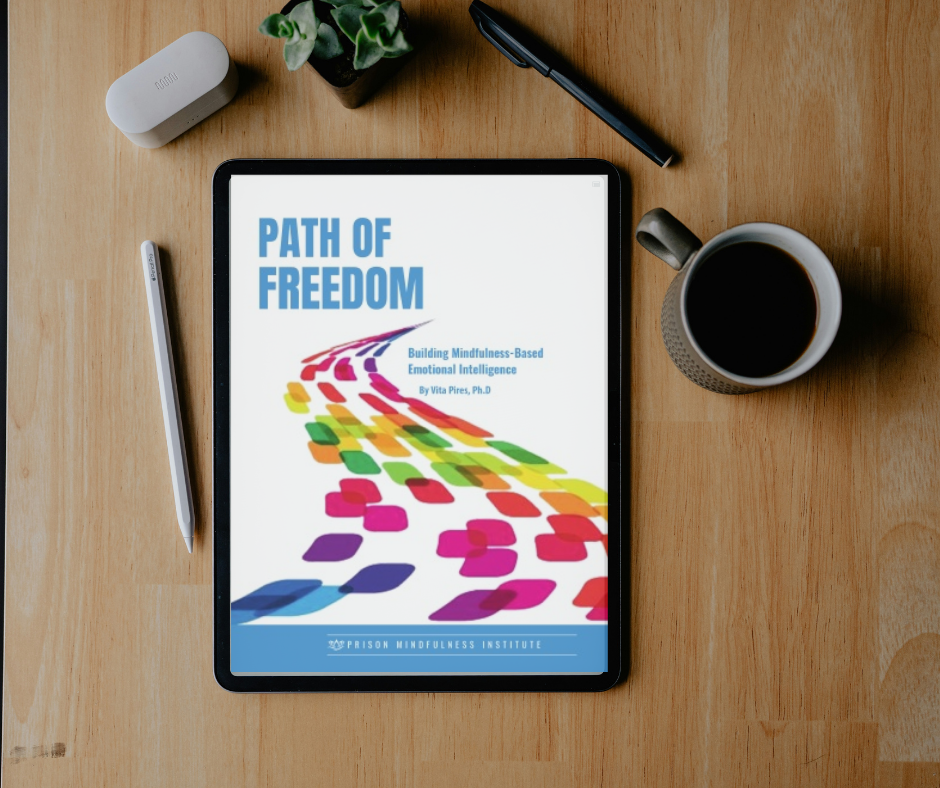
Path of Freedom brings mindfulness-based programs to incarcerated individuals and correctional staff. Our volunteers receive training in both contemplative practice and the unique dynamics of teaching in correctional environments.
If you are interested in learning more about Path of Freedom, we offer our six-week online course Introduction to the Path of Freedom (POF) on our EMI Community & Courses site.
2026 Dates:
Cohort One/ March 2nd- April 13th
Cohort Two/ Oct 5th- November 16th

Comments