
What It Feels Like to Walk Into a Prison

Updated: Feb 26
Reflections from volunteer mindfulness teachers working inside correctional facilities

Walking through the gates of a correctional facility for the first time is not something you can fully prepare for. The metal detectors, the control room staff, the locked doors — it all carries a weight that settles on you before you even reach the people you came to teach.
And yet, for many of us who keep going back week after week, something unexpected happens inside those walls: we find genuine connection, humility, and growth.
Arriving With Honest Eyes
It would be naive to pretend there's nothing to be afraid of. People in correctional facilities are navigating enormous stress — and so is everyone around them, including staff. Chaotic situations can arise without warning. Acknowledging that reality doesn't make us fearful teachers; it makes us honest ones.
What we've learned is that fear, when it's there, doesn't have to define the room. Our job is to walk in grounded and present, even when the environment is anything but.
One teacher describes her first visit vividly: "The place looked cold and industrial. I took a chair in the middle of a room of participants, all staring at me." But very quickly, their enthusiasm for the practice changed everything. "Their interest in discussing the class material.changed my fear into love."
Learning to Let Go of Control
For those of us accustomed to structured, predictable environments, prison teaches a very particular lesson early: you are not in charge of the timeline.
One teacher recalls realizing on her third visit that no amount of urgency would get her through the gate any faster. The staff at the front — ranging from pleasant to indifferent — operated on their own rhythm. The only option was to be present and at ease with that.
That lesson proved useful far beyond the entrance. When a student doesn't show up for class, it's tempting to search your memory for what you might have done wrong. It took time to understand that court appearances, unit lockdowns, and countless other factors have nothing to do with you. Releasing that kind of ego investment opens up a lot of space.
The Teacher Becomes the Student
Many volunteers come in expecting to offer something. What surprises them is how much they receive.
"The teaching is reciprocal," one mindfulness instructor writes. "I get a lot of inspiration and knowledge from exploring topics like fear, judgment, pain, and listening with the people I teach. I have experience educating physicians and the public on topics I'm scientifically confident in — but teaching mindfulness, when I'm still learning it myself, challenges me to show up more fully every single day."
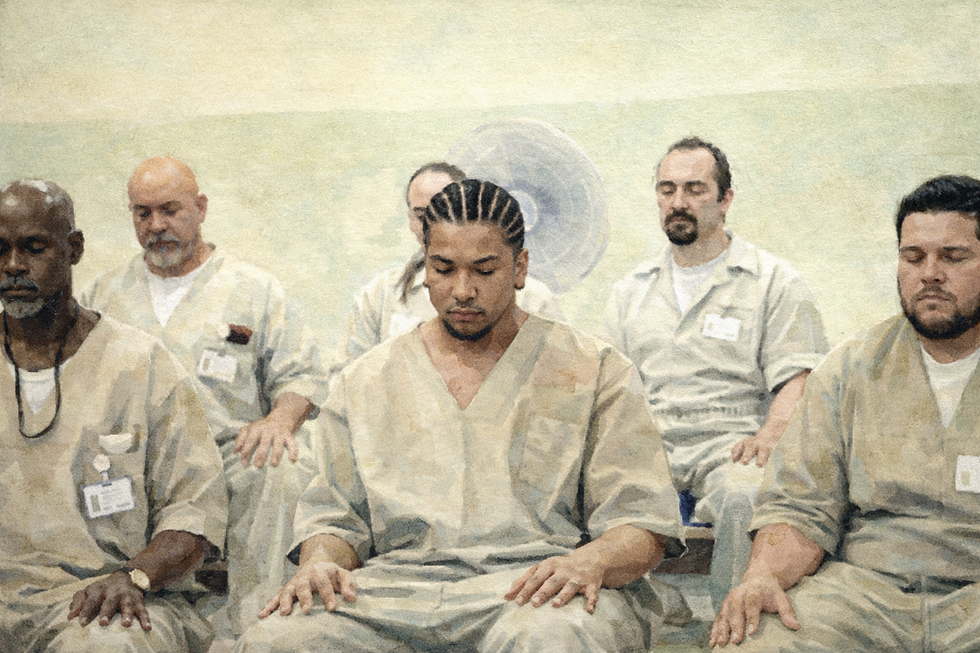
What Happens When We Sit Together
When we actually get into the room, something shifts.
Sometimes the group's focus is extraordinary. Other times, restlessness fills the space, and we work with whatever is there. When there's a lot of acute pain in the room — a group of women recently incarcerated, still processing the shock of their first day — a loving kindness meditation can bring a noticeable calm. We sit around a table. We begin with posture. We breathe.
Staying With It
These environments ask a lot of volunteers. The logistics are unpredictable, the emotional terrain can be heavy, and the systems we're working within were not designed with healing in mind.
But week after week, teachers come back. Because what happens in those rooms — however imperfect, however constrained — is real. People who are rarely offered stillness find it. People who feel forgotten find someone willing to sit with them and listen. And teachers who thought they were giving something discover they're receiving something they didn't know they needed.
Walking into a prison changes you because it asks you to be present with the full weight of human complexity — and to keep showing up anyway.
As our volunteers share above, teaching in a correctional facility is a reciprocal experience that challenges you to show up more fully every day. Interested in learning the unique skills required for this work?
Path of Freedom offers comprehensive training for those looking to bring mindfulness to incarcerated individuals and staff alike.
Join an upcoming 2026 Cohort: Register for our six-week online Introduction to the Path of Freedom (POF) via the EMI Community & Courses site.
Spring Session: March 2nd – April 13th
Fall Session: October 5th – November 16th


This blog is very powerful and emotional. It clearly explains how it feels to enter a prison. I really liked how Prison Connect ideas are reflected in building human connection.